
When flies turn up a few at a time, they're usually wandering in through a door. When a dozen or more appear at once — especially in one room — that's a different problem. A sudden surge almost always means flies hatched inside your home, and until you find what they hatched in, killing the adults only buys you a few days.
Why "sudden" is the useful clue
Most common indoor flies go from egg to adult in roughly a week to ten days, and they emerge in batches. So a swarm that shows up overnight isn't an invasion from outside — it's a batch of eggs laid a week ago finishing up. Somewhere in the house there is damp organic material that a fly found suitable.
Identify the fly — it tells you where to look
- Small, hovering near fruit, drains, or recycling — fruit flies. The source is fermenting sugar: overripe produce, a spill under an appliance, empty bottles and cans.
- Small, fuzzy, moth-like, resting on walls near a sink or tub — drain flies. The source is the organic film inside a drain.
- Larger, loud, bumping against windows — house flies or blow flies. The source is decaying material: garbage, pet waste, or an animal that died in a wall, attic, or crawlspace.
- Slow, clustering at sunny windows in fall or a warm winter spell — cluster flies. These overwinter in wall voids and attics rather than breeding indoors.
The five places to check first
- Trash and recycling — including the residue at the bottom of the bin, and any bag that sat a day too long.
- Drains — kitchen, bathroom, floor drains, and any bathroom that doesn't get used often.
- Produce and pantry — one forgotten potato, onion, or piece of fruit is a common culprit.
- Under and behind appliances — spills that ran beneath the fridge, stove, or dishwasher.
- Pet areas — food bowls, litter, and waste in the yard near a door.
If none of those turn anything up and the flies are large and slow, check for an odor near walls, vents, or the attic. A dead rodent or bird is the usual explanation, and the flies will keep coming until it's removed.
Clear the source, then thin out the adults
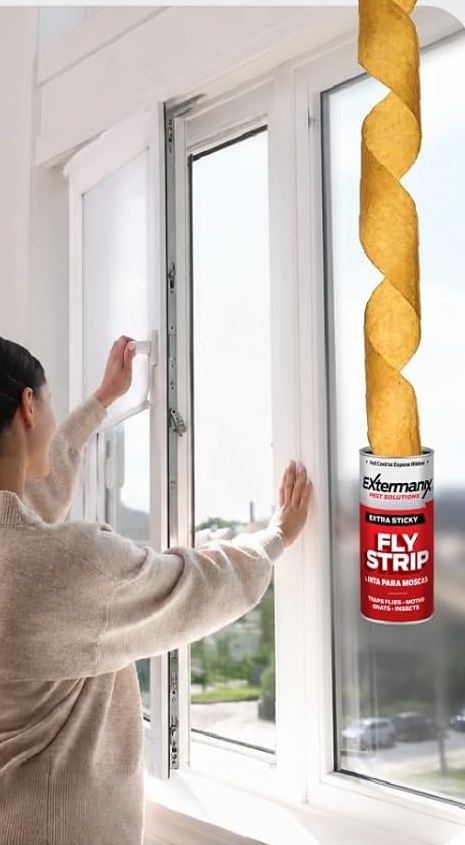
Removing the breeding site stops new flies from arriving. It does nothing about the adults already in the air, and those can live for weeks. That's the gap fly strips fill: hang them where the flies gather — usually a window, or above the area where you found the source — and let them bring the existing population down while the source stays clean.
If the flies return on roughly the same schedule, you missed a source. Start looking again about a week out.